Key Takeaways
- Postpartum anxiety is treatable, and learning how to help postpartum anxiety starts with naming what you’re feeling without shame.
- Racing thoughts, constant worry, and physical restlessness are common symptoms, not signs of failure as a parent.
- Daily coping tools (sleep protection, grounding, reducing information overload) ease symptoms but rarely resolve anxiety on their own.
- Therapy, particularly cognitive behavioral approaches, has strong evidence behind it for postpartum anxiety specifically.
- Support is available by video from home, with no waitlist and no need to arrange childcare for an in-office visit.
When your mind won’t stop running through worst-case scenarios about your baby, your body, or your ability to cope, you start to wonder if something is wrong with you. It isn’t. Postpartum anxiety is one of the most common experiences of early parenthood, and learning how to help postpartum anxiety is possible once you understand what’s actually happening and what response the evidence supports.
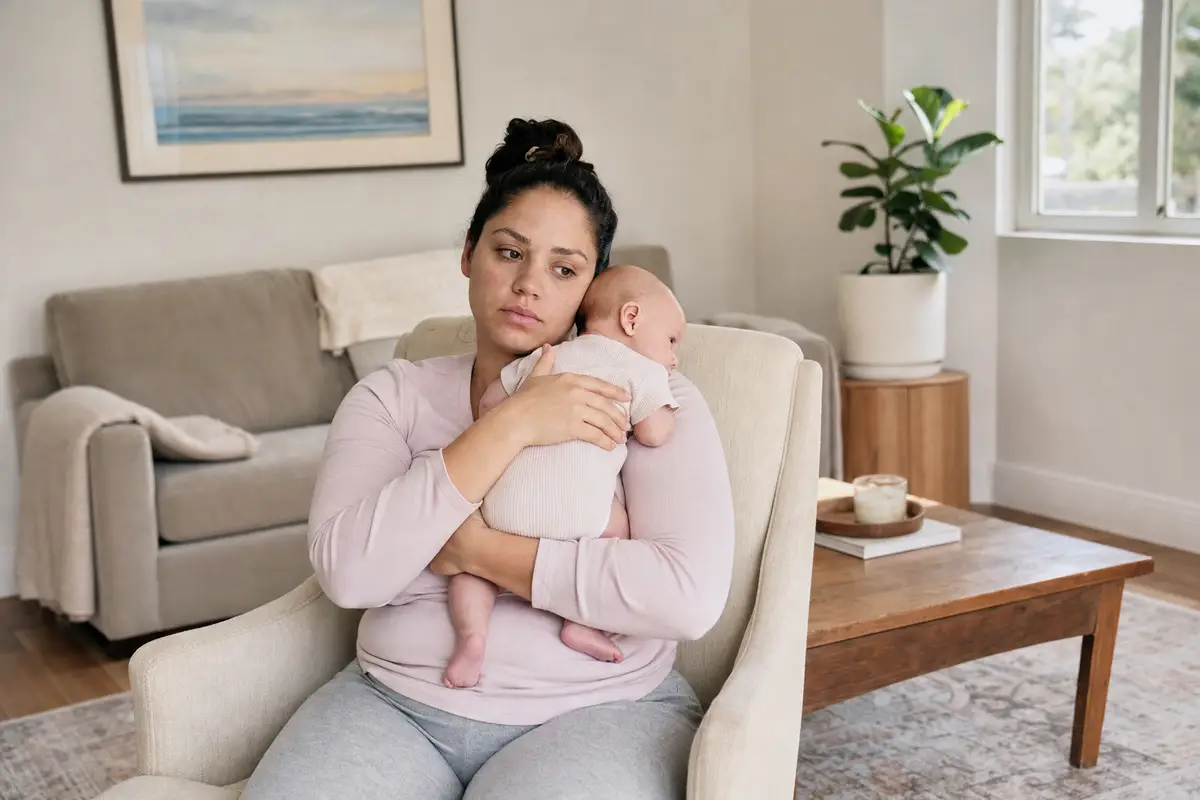
Many new parents describe it the same way: a hum of dread that won’t switch off, checking the baby’s breathing over and over, intrusive thoughts about accidents or illness, a body that feels keyed up even when exhausted. You function. You look fine from the outside. Inside, your nervous system does not register that the danger has passed, and that gap between appearance and experience is exhausting on its own.
What postpartum anxiety actually looks like
Postpartum anxiety shows up as persistent, excessive worry that interferes with daily life in the weeks or months after having a baby. It is different from the normal watchfulness that comes with caring for a newborn. The difference is scale and duration: normal vigilance fades as you settle into a rhythm, while postpartum anxiety stays constant or grows. If you want a fuller picture of symptoms and how clinicians distinguish it from general new-parent nerves, this guide to what postpartum anxiety is breaks down the diagnostic picture in plain language.
Common signs include a racing heart or tight chest with no clear trigger, trouble falling or staying asleep even when the baby is sleeping, repetitive ‘what if’ thoughts, and a felt need to control every variable around the baby’s safety. Some people also experience irritability or a short fuse, which overlaps with postpartum rage, a related but distinct experience worth understanding on its own terms. These symptoms arrive together for many parents, compounding each other until ordinary tasks feel heavier than they should.
None of this means you are a bad parent or that you don’t love your baby. Anxiety after birth is driven by a mix of hormonal shifts, sleep deprivation, and the sheer weight of new responsibility landing all at once. It is a response your body is having, not a character flaw. Your body is reacting to a genuine overload of change, not malfunctioning on its own.
How to help postpartum anxiety day to day
The first layer of how to help postpartum anxiety is practical: small, repeatable actions that calm an overactive nervous system. These reduce the intensity of anxiety enough to make the rest of your day possible, even though they do not eliminate it on their own. Think of them as load-bearing habits rather than cures.
Protect sleep even in small amounts
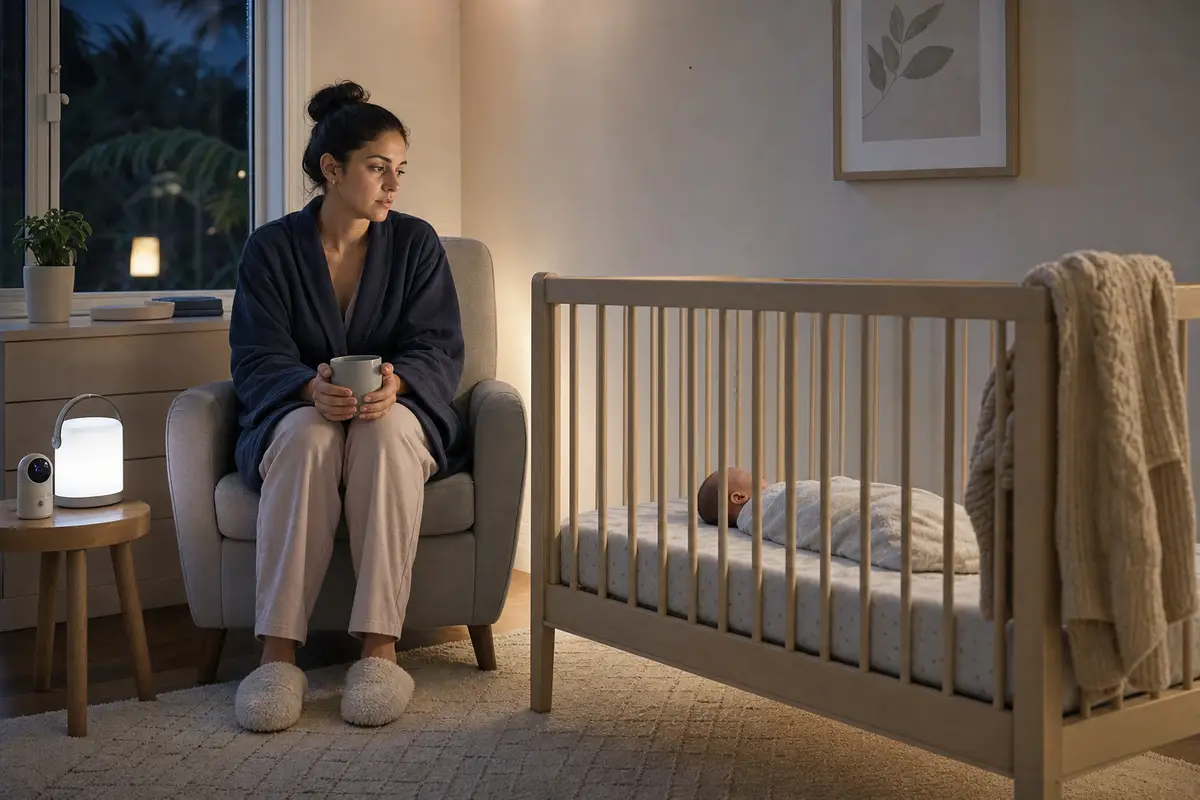
Sleep deprivation amplifies anxiety symptoms directly. A single uninterrupted four-hour stretch changes how your brain processes worry the next day. If a partner, relative, or friend takes one night feeding or one early morning shift, that block of sleep is not a luxury. It is a treatment, and it belongs on the same priority level as a medical appointment. Ask directly for this help instead of waiting for someone to offer it. A single extended sleep block shifts your capacity to manage worry the following day, and protecting even one stretch changes the baseline for everything else.
Reduce the information intake
Constant searching for symptoms, milestones, or worst-case scenarios online feeds anxiety rather than resolving it. Consider a parent who checks a baby monitor app forty times a night, each check producing brief relief followed by a new worry. Setting a specific, limited window for research (one search session, one question answered, then closing the tab) breaks that loop. The goal is not to stop caring about information; it is to stop the compulsive checking pattern that keeps your nervous system in a constant state of alert. Write down the question, answer it once, and close the tab for the rest of the day.
Name the thought out loud
Saying an anxious thought aloud, to a partner, a friend, or even to yourself in an empty room, changes its grip. Thoughts that circle silently in your head feel bigger and more certain than they do once spoken. This is a simple technique, and it works because it interrupts the loop rather than feeding it. Speaking the thought forces your brain to process it as language instead of raw sensation, which shrinks it down to a manageable size. Try this the next time a worry repeats itself for the third or fourth time in a row.
Use your body to calm your body
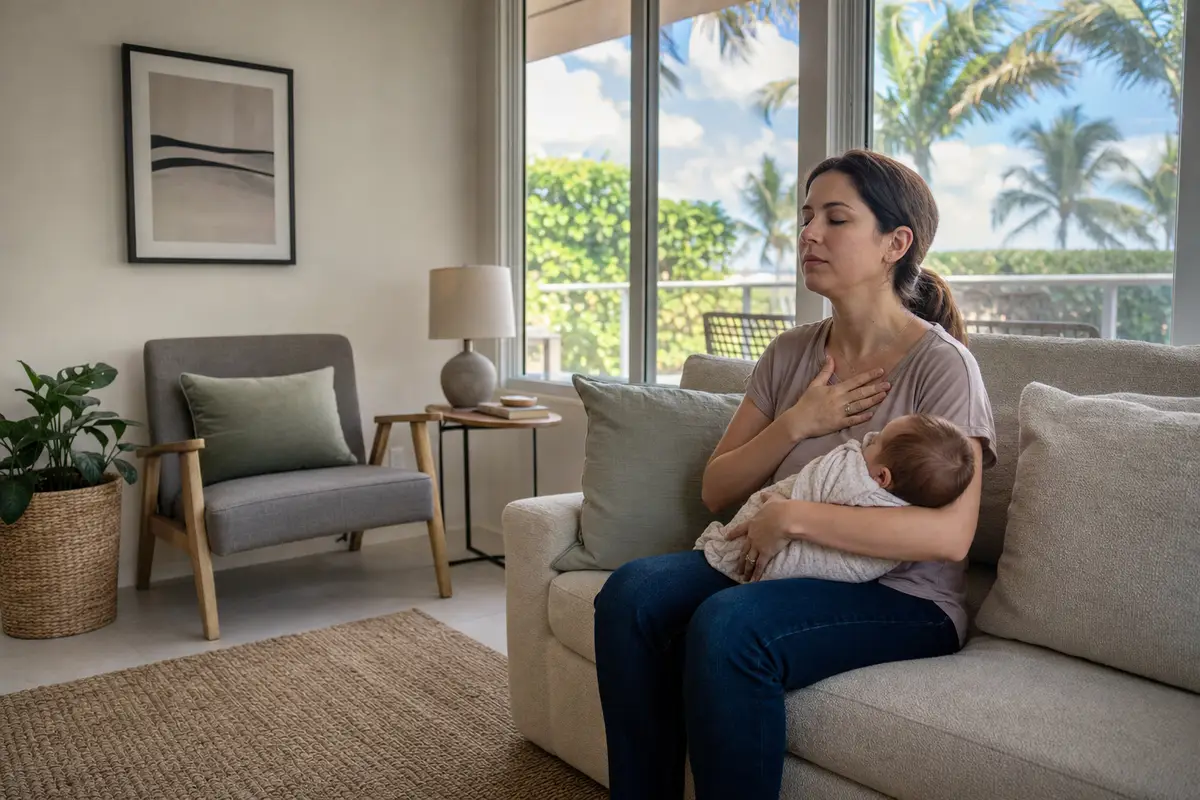
Slow exhale breathing (a longer out-breath than in-breath) directly signals your nervous system to downshift. So does cold water on the wrists, a short walk outside, or stepping away from the baby for five minutes while someone else holds them. These are not indulgences. They are functional interruptions to a stress response that has gotten stuck in the on position. The body responds to these signals faster than the mind responds to reasoning, which is why physical techniques work even when you don’t feel ready for them to.
When daily strategies aren’t enough
Coping tools matter, but they have a ceiling. If worry is constant, if it disrupts sleep even when the baby is sleeping, or if it is shrinking your world (avoiding outings, refusing help from others, feeling unable to leave your baby with anyone), that is a sign the anxiety has moved past what self-management handles alone.
Therapy for postpartum anxiety works. Cognitive behavioral therapy, which helps identify and restructure the specific thought patterns driving the worry cycle, has a strong evidence base for anxiety disorders generally and is widely used for postpartum presentations specifically. A licensed clinician also assesses whether symptoms meet criteria for a postpartum anxiety disorder versus adjustment-related stress, which changes what treatment looks like and how long it takes.
There’s also a timeline question many parents ask. If you’re wondering how long postpartum anxiety typically lasts or when it resolves, both questions have real answers, and neither answer is ‘forever.’ Untreated anxiety persists for months or longer in many cases. Treated anxiety has a shorter, more predictable course, with measurable improvement visible within weeks of starting structured therapy.
Does talking to a therapist really make a difference?
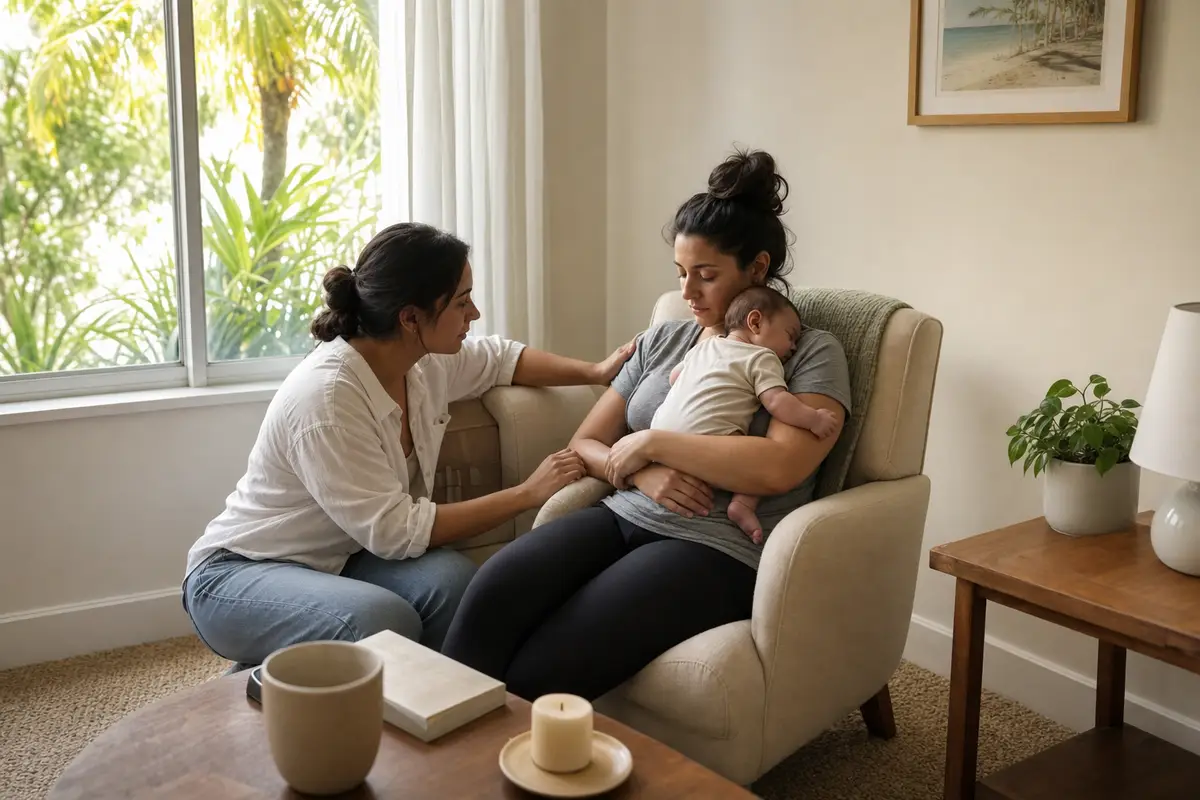
Yes. Therapy gives you a structured way to interrupt anxious thought patterns instead of just riding them out. A therapist trained in postpartum mental health teaches specific techniques for intrusive thoughts, helps you separate normal parental vigilance from anxiety-driven hypervigilance, and tracks whether symptoms are improving over weeks rather than leaving you to guess.
For many new parents, the idea of adding one more appointment feels impossible. That is a real barrier, not a weak excuse. It is also one that has a direct workaround, and understanding that workaround removes a major reason people delay getting help.
What if you can’t leave the house for an appointment?
You don’t have to. Video-based therapy sessions happen from wherever you are, including your couch, with the baby nearby, during a nap window, or whenever your schedule allows. There is no commute, no waiting room, and no need to find someone to watch the baby while you drive somewhere.
This matters because the people most in need of support for postpartum anxiety are often the least able to arrange a traditional appointment. A new parent running on broken sleep, managing feedings, and rarely leaving the house for anything but pediatrician visits does not need one more logistical hurdle. They need the care to come to them, on their timeline, without an extra errand attached to it.
Common questions about postpartum anxiety
Is postpartum anxiety the same as postpartum depression?
No. Postpartum depression centers on persistent sadness, low mood, and loss of interest in things you used to enjoy. Postpartum anxiety centers on excessive worry, racing thoughts, and physical tension. The two frequently occur together, but they are distinct conditions with real differences in symptoms and treatment emphasis, and a clinician evaluates for both rather than assuming one explains the other.
Will postpartum anxiety go away on its own?
Mild anxiety can ease as sleep improves and routines stabilize. For many parents, though, symptoms persist or worsen without active treatment. There is no reliable way to predict in advance which path your anxiety will take, which is why early support matters more than waiting to see what happens.
Is it normal to have scary intrusive thoughts about the baby?
Intrusive thoughts (unwanted, disturbing mental images of harm coming to the baby) are extremely common with postpartum anxiety and do not mean you want to act on them or that you are a danger to your child. They are a symptom of anxiety, not a prediction of behavior. Talking to a clinician about them removes the shame and gets you an accurate read on what is happening in your specific case.
How soon after having a baby can postpartum anxiety start?
Symptoms begin within the first days after birth for some parents, during the weeks that follow for others, or months later, sometimes after a parent returns to work or a partner’s support changes. There is no single starting window, and anxiety that appears later is just as legitimate as anxiety that starts immediately after delivery.
If you or someone you know is in immediate danger, call or text 988 (Suicide & Crisis Lifeline).
Getting support without adding to your load
You’ve spent weeks or months managing worry on your own, maybe without even telling anyone how loud it’s gotten. That’s enough. The next step doesn’t have to be complicated.
Better You Therapy is a Florida-licensed mental health practice providing teletherapy statewide and on-site clinical services in Southeast Florida senior-living communities. For new parents, that means video sessions from home, scheduled around your baby’s routine, with no waitlist and no need to navigate referrals or paperwork alone. Visit our home page to find a time that works, or explore more postpartum resources to learn what else is going on.